











Dual Action, Gear Driven or Rotary? A Beginner’s Guide to Polishing Machines
6 min read
If you’re just getting into paint correction, one of the first questions you’ll face is: which polishing machine do I need? Walk into any detailing supplier or browse online for five minutes, and you’ll find three main types — Dual Action (DA), Gear Driven Dual Action, and Rotary. They all spin a pad on paint, but they work very differently, and choosing the wrong one at the wrong stage can be very frustrating — and in some cases, very risky.
Here’s a breakdown of each — what they do, how they feel to use, and who they’re actually for.
Dual Action Polisher (DA) #
The DA is where almost everyone should start, and for good reason.
A Dual Action polisher moves in two ways at once — in a random orbital pattern, which is forced by the machine, and also a rotary motion. The speed of that rotary motion is dictated by the orbital movement: the faster the orbital speed, the faster the rotary motion. That constant change of direction of orbital motion is the key. It makes it much harder to build up heat in the paint, which is why a DA is far less likely to leave buffer trails or holograms compared to a rotary. Simply put, a DA is far more forgiving than the alternatives.
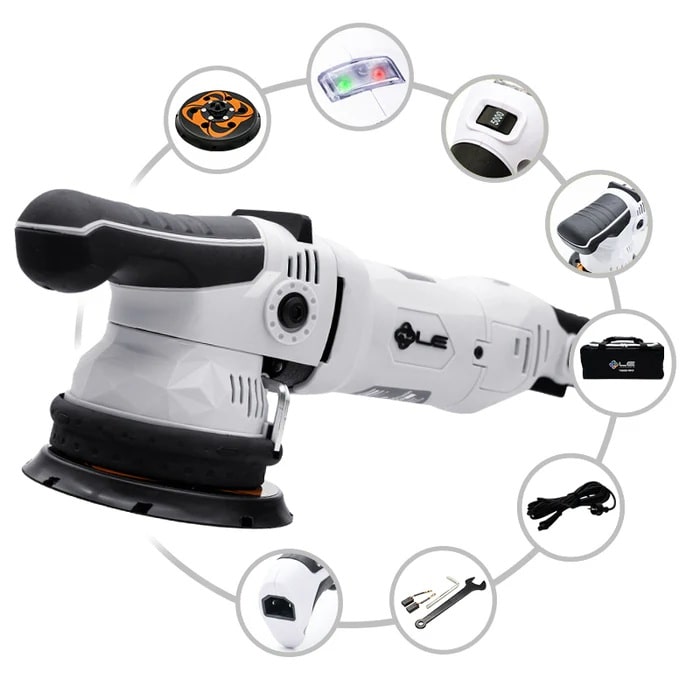
That doesn’t mean it’s a toy. A DA polisher used properly — with the right compound and the right pad — can remove swirl marks and scratches effectively. For most car enthusiasts and people getting into detailing, a DA will handle the majority of what they need.
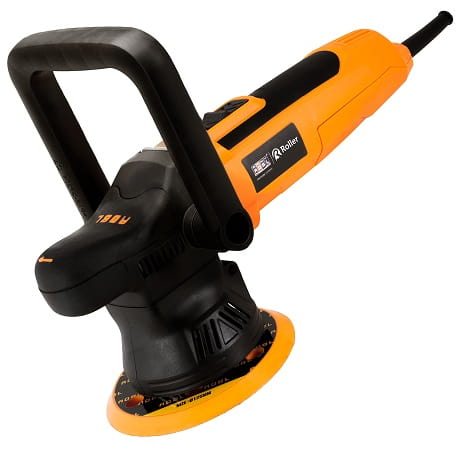
It’s also worth knowing that not all DA polishers are the same. They come in different throw sizes — typically 9mm, 15mm, and 21mm. The higher the throw, the more cutting power the machine has. A smaller throw means a more delicate, refined action — less aggressive, but a better choice for finishing stages where you want to refine the paint rather than cut into it.
What it’s good for:
- Removing swirl marks and light scratches
- Everyday paint enhancement work
- Learning how to polish without the risk of damaging paint
Who it’s for: Anyone starting out. Full stop. If you’ve never used a machine polisher before, a DA is where you begin.
The limitation: Depending on the throw size, a DA will take longer to cut through serious defects than a gear driven or rotary polisher. It’s capable — but not always the fastest tool for heavy correction work.
Gear Driven Dual Action Polisher #
Think of this as the middle ground between a DA and a rotary — a step up in aggression, while still keeping some of the safety net.
A Gear Driven DA looks similar to a standard DA, but the movement is fundamentally different. Instead of a free-floating rotary movement, the head is driven by gears, meaning it maintains a consistent, combined rotary and orbital motion regardless of how much pressure you apply. That consistency is what gives it significantly more cutting power than a standard DA.
The trade-off is that it’s less forgiving. Because the machine keeps working in a predictable, consistent pattern, there’s a greater risk of generating heat if you’re not paying attention. It requires a better understanding of pad and compound selection, and more awareness of how the machine is behaving on the surface at all times.
What it’s good for:
- More aggressive paint correction — swirl marks, deeper scratches, heavier oxidation
- Situations where a standard DA isn’t making enough progress
- Detailers who have some experience and want more cutting ability
Who it’s for: Someone who has already spent time with a standard DA, understands how machine polishing works, and needs more power for tougher jobs. It’s not the right first machine.
The limitation: More power means less margin for error. Without some experience behind you, it’s easier to cause problems with a gear driven machine than with a standard DA.
Rotary Polisher #
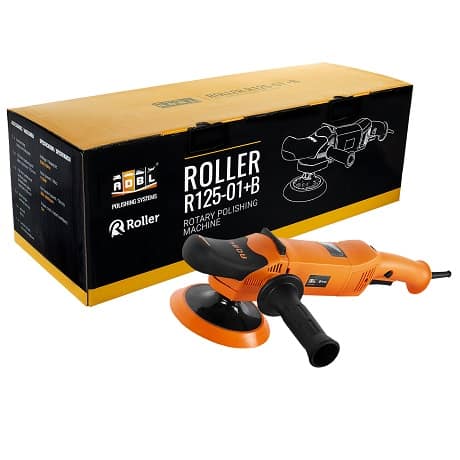
The rotary is the most powerful and most demanding machine in the detailing world. It spins in one direction only — a fixed, continuous rotation. There’s no orbital movement, no randomness, no safety net.
In the right hands, a rotary can remove defects very fast. However, it also generates heat quickly if you don’t control it properly, and it has more cutting ability than anything else in the workshop. For serious paint correction — heavily neglected paintwork, deep scratches, vehicles that need significant work before protection goes on — the rotary is the tool that gets it done fastest.
But that power comes with serious responsibility. The rotary will not forgive mistakes. Apply too much pressure in one spot, slow down at the wrong moment, or use the wrong combination of pad and compound, and you can burn through the clear coat in seconds. On thinner paints, the margin for error is extremely small.
Professionals use rotaries because they’ve spent years learning how paint behaves, how much heat different surfaces can handle, and how to read what the machine is doing at all times. It’s not a machine you pick up and figure out as you go.
What it’s good for:
- Heavy paint correction on seriously defected paintwork
- Situations where speed and cutting power matter
- Final finishing in experienced hands (with the right pad and polish)
Who it’s for: Experienced detailers who understand paint systems, have solid machine polishing skills, and know exactly what they’re doing. Not for beginners.
The limitation: High risk in inexperienced hands. One mistake can cause damage that can’t be undone without a respray.
So, Which Polisher Should You Start With? #
If you’re new to machine polishing — the answer is a Dual Action polisher, without hesitation.
It will teach you how to read paint, how to select the right pad and product, how to work in sections, and how to build the muscle memory that machine polishing requires. Once you’re comfortable with all of that, you’ll be in a much better position to decide whether you need more power — and you’ll understand exactly why.
Jumping straight to a gear driven or rotary machine because you want faster results is one of the most common mistakes beginners make. The result is usually lack of desired results or damaged paint and an expensive lesson.
Start with a DA. Learn the process. The results will follow.
Understanding your tools is one of the foundations of good detailing work. If you want to go deeper — pad selection, compound types, how to read paint before you start — explore the rest of the knowledge base. And if you have specific questions about your car or your setup, feel free to get in touch.
Have a question or something to add? Drop a comment below — whether it’s a question, your own experience, or something you’d do differently. We read everything.


Leave a Reply
You must be logged in to post a comment.

Leave a Reply #