











Why Can’t I Remove Scratches? The Truth About Polishing Compounds, Pads and Machines
7 min read
If you’ve been searching for the best polishing compound, the best pad, or the best machine — and you’re still not getting the results you expected — this article is for you. I’m going to explain how polishing actually works, logically, from the ground up. Because once you understand what’s really happening when you polish paint, a lot of things start to make sense.
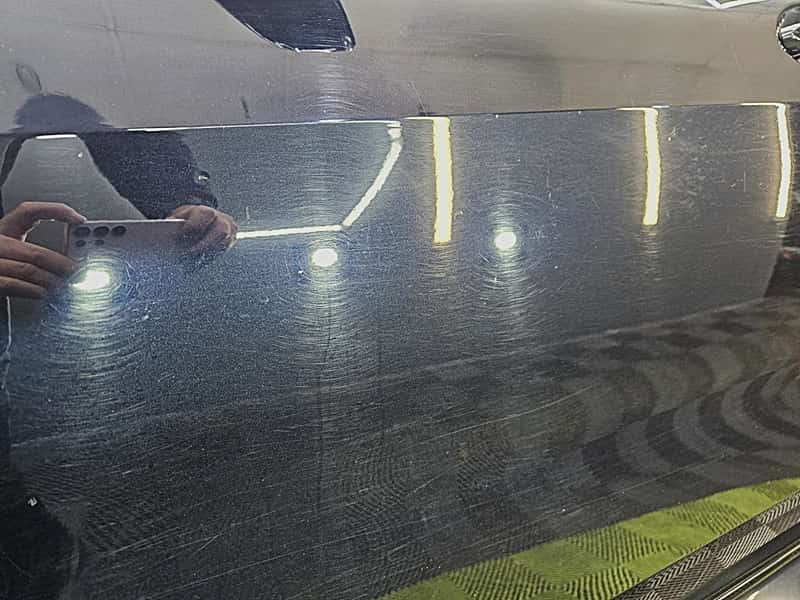
What Paint Correction Actually Is — and What It Isn’t #
Let’s get one thing straight from the beginning: paint correction is not just holding a polisher and moving it across a panel. Almost anyone who buys a machine can do that. That’s not paint correction — that’s just moving a machine around.
Paint correction is the conscious, controlled removal of a micro-layer of damaged paint.
Here’s what most people don’t realise: we’re not actually removing scratches or swirl marks in the way you might think. Scratches are damage within the paint — they’re depressions, low points in the surface. What we actually do is remove the paint around those low points, levelling the surface down to the depth of the damage. Once the surface is flat and even, light reflects off it uniformly — and that’s why properly corrected paint looks, in most cases, like new.

The Real Reason Your Polishing Isn’t Working #
Most people buy one machine and then spend hours — sometimes a lot of money — searching for the perfect compound or the perfect pad. They buy the most recommended products, follow the advice online, and still don’t get results. Why?
The biggest reason is a misunderstanding of how polishing actually works.
Sliding a machine across paint will produce some random effect — but only the correct use of the right machine, pad, and compound together will produce the result you’re actually looking for.
Polishing is the removal of a micro-layer of paint. And what removes paint? Think about it simply — if you’re cutting anything, you need two things: motion and abrasion. Together, applied correctly, they create friction — and friction removes the surface.
In polishing:
- Motion comes from the polishing machine
- Abrasion comes from the pad and the compound
- Lubrication also comes from the compound — which is what allows the process to work in a controlled way without damaging the surface unpredictably
(Older polishing compounds actually required the addition of water for lubrication — you may have heard of this. Modern compounds have enough lubrication built in, so that’s no longer necessary.)
The result of your polishing work is not determined by finding the “best pad” or the “best compound” alone. Polishing is a three-part system — machine, pad, and compound. Only the right combination of all three, used correctly, produces the result you’re after. The tools on their own mean nothing. What you do with them is everything.
How Polishing Compounds Actually Work #
There are a lot of myths and theories floating around about compounds, so let me be direct about this.
Some people are afraid to use a heavy cut compound because they think it will remove all their paint. Others believe that only a finishing polish delivers gloss. Some always run three full stages — heavy, medium, finish — on every single car regardless of its condition. And I’ve heard from people who swear a particular compound works on everything, while others say that exact same compound does nothing for them.
Here’s the truth: compounds are not magic liquids. They don’t add gloss. Their job is to remove paint.
Every compound — whether it’s a heavy cut, medium cut, or fine finishing polish — contains abrasives. The difference between them is simply the level of abrasion:
- Heavy cut — aggressive abrasion, designed to tackle significant defects and hard paint
- Medium cut — moderate abrasion, a balance between correction and refinement
- Fine cut / finishing polish — very gentle abrasion, used to refine the surface after heavier stages
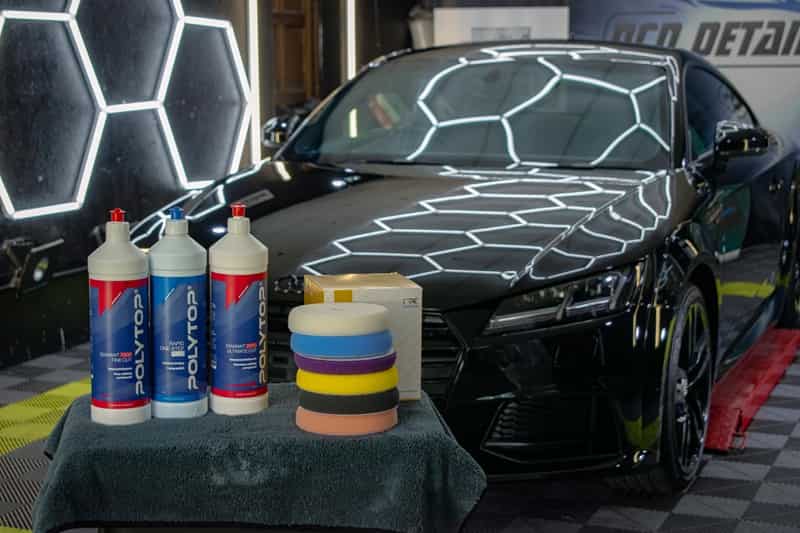
That’s it. The gloss you see after polishing comes from the flat, even surface the process creates — not from anything the compound adds to the paint.
When it comes to polishing pads — exactly the same logic applies. A cutting pad increases the aggressiveness of the combination. A finishing pad reduces it. Neither the pad nor the compound does the job alone.
Paint Hardness — Why It Changes Everything #
Not all paints are the same, and understanding this is one of the most important things you can know before you start polishing.
In detailing, we talk about hard, medium, and soft paints. Many German cars have hard paint. Older Japanese cars can be extremely soft. Italian, French, and Korean vehicles tend to sit in the middle.
This matters because the level of controlled friction you need to generate depends entirely on the hardness of the paint you’re working on.
Working on heavily defected hard paint is the most demanding scenario. You need to generate the most friction to make meaningful progress in a reasonable amount of time. When using a Dual Action polisher on hard paint, there are four key factors to control:
- The orbital motion of the machine must be maintained at all times. Too much downward pressure, or tilting the machine, will slow or stop that movement. The result is either very poor correction, or it takes an enormous amount of time.
- Machine speed. The higher your speed — controlled — the more friction you generate and the faster the work progresses. Running the machine too slow on hard paint means very little is actually happening.
- Pressure. On a DA polisher, pressure can help — but only if it doesn’t slow the machine down. Controlled pressure that maintains the machine’s speed accelerates the work. Too much pressure kills the orbital motion and the process stops working.
- Arm speed. The slower you move the machine across the panel, the more opportunity you give the combination to do its job. But this also needs to be controlled — moving too slowly in one spot builds up heat.
On medium or soft paints, these same four factors apply — but with less intensity. Things happen more easily, and you need to be careful not to over-correct.
Why Blaming the Tools Is the Wrong Approach #
A lot of people blame their equipment when results aren’t there. “This machine leaves holograms.” “That compound doesn’t remove scratches.” “This pad doesn’t do anything.”
Here’s my honest view on that: every machine can polish paint. But each has its strengths and its limitations, and understanding those is the key.
A small DA polisher will take a lot long time on hard, heavily defected paint — not because it’s a bad machine, but because it’s not the right match for that particular job. A rotary polisher used on soft paint will leave holograms — not because it’s a bad machine, but because it generates more heat and aggression than soft paint can handle without leaving marks behind.
If something isn’t working, the answer is almost always in how the tools are being used — not in the tools themselves. That’s always where I look first.
The Short Version #
Polishing is not magic. It’s physics — the controlled cutting of a surface through the right combination of motion, abrasion, and lubrication.
- Machine → motion
- Pad → abrasion
- Compound → abrasion + lubrication
A better pad, a more expensive compound, or a different machine on its own usually doesn’t change much. What produces the result is the correct combination of all three, matched to the paint condition you’re working on, and applied with proper technique.
Think of it like this: if you need to cut through concrete, you’re not going to reach for a wood saw — even the best wood saw available. That’s simple and logical. In detailing, this logic is surprisingly easy to lose, mainly because of the amount of theory and misinformation that circulates online.
The right combination, used correctly, for the surface in front of you. That’s what gets results — every time.
Have a question or something to add? Drop a comment below — whether it’s a question, your own experience, or something you’d do differently. We read everything.


Leave a Reply
You must be logged in to post a comment.

Leave a Reply #