











Dual Action vs Rotary Polisher — What’s the Real Difference?
7 min read
When people ask me about the difference between a Dual Action and a rotary polisher, the conversation usually starts in the wrong place. Most of the time they’ve read something online about one being “safer” or the other being “only for professionals” — and neither of those things really gets to the point.
Both machines remove paint. That’s what polishing is. The question is how they do it, and what that means in practice when you’re standing in front of a car with a polisher in your hand.
How a Dual Action Polisher Works — and Why It’s More Forgiving #
A Dual Action polisher works by combining two movements at once — a rotation and an orbit. The pad spins, but it also moves in a circular path around a central point at the same time. These two movements happening together mean the pad is constantly changing direction as it works across the paint.
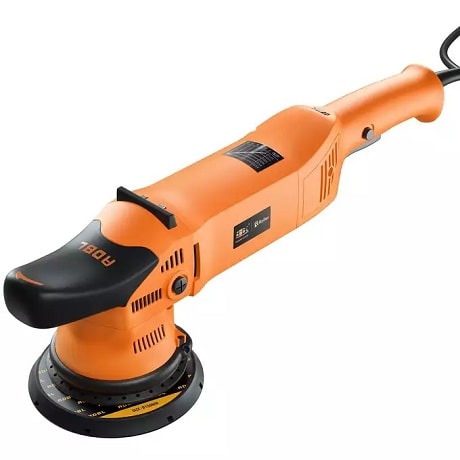
That constant change of direction is what makes a DA polisher behave the way it does. Because the friction is spread across a wider, always-changing pattern, heat builds up slowly and evenly. There’s no single point on the panel that’s getting hammered consistently — the energy is distributed. This is why you can work with a DA for a reasonable amount of time on a section without having to worry too much about overheating the paint.
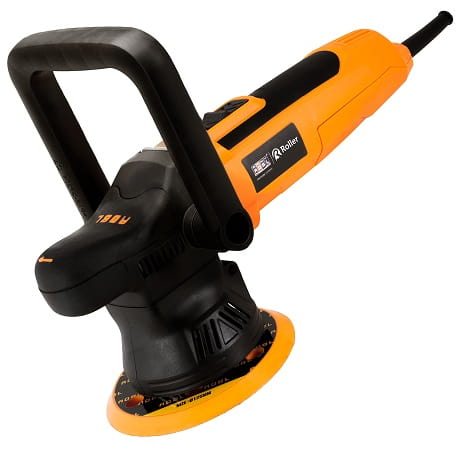
It also means that creating holograms — those fine, directional marks left by a machine moving in a consistent pattern — is much harder with a DA. The random movement doesn’t leave a consistent trace in the paint the way a fixed rotation does.
How a Rotary Polisher Works — and Why Heat Control Is Everything #
A rotary polisher spins in one direction only. Fixed, continuous, always the same. There’s no orbit, no randomness — just a direct, concentrated rotation.
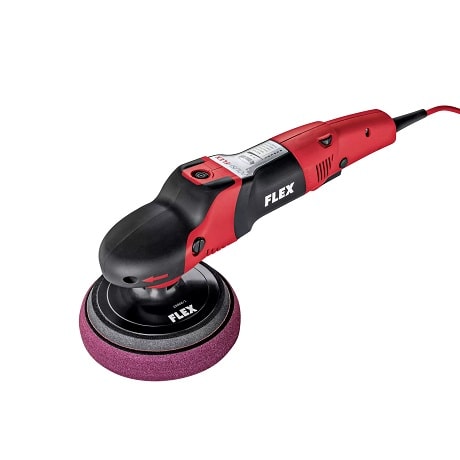
This is why a rotary cuts faster than a DA. The friction is direct and consistent, and it doesn’t spread out the way a DA does. On hard paint with serious defects, that concentrated cutting power is exactly what you need to make real progress in a reasonable amount of time.
But here’s the thing that matters most with a rotary: heat builds fast, and it builds across the entire surface you’re working.
Because the movement is always in the same direction with no randomness, the rotary builds heat across the entire surface being worked — consistently and continuously. On open, flat panels this is manageable with the right speed and arm movement. Where it becomes genuinely dangerous is on edges, sharp body lines, and angled surfaces. On those areas, the contact between the pad and the paint drops to a very small point, and that concentrated contact generates heat much faster than working a flat panel. This is where most paint damage from a rotary happens.
Controlling this comes down to one thing above everything else: machine speed. The correct approach is to adjust your speed so that the panel doesn’t overheat — not to simply keep the machine moving and hope for the best. Lower speeds on edges and delicate areas, appropriate speed on flat panels, and constant awareness of how warm the surface is getting. That’s what proper rotary technique looks like. This is what people mean when they say a rotary requires more experience — it’s not about operating the machine itself, it’s about reading and managing what’s happening to the paint in real time.
DA vs Rotary Polisher — The Practical Difference in Real Detailing Work #
In practice, these two machines feel very different to use.
With a DA, the main thing to manage is keeping the orbital motion active. If you apply too much pressure or tilt the machine, that orbital movement slows down or stops — and when it stops, the machine loses most of its effectiveness. A lot of people who say a DA “doesn’t work” on hard paint are experiencing exactly this. The machine is fine. The technique is killing the motion.
With a rotary, the machine will always rotate regardless of pressure or angle. That consistency is an advantage in terms of cutting power, but it also means the machine won’t warn you when you’re doing something wrong. A rotary generates strong friction by nature — and with that comes heat. That heat is not the problem in itself. The problem is when it’s not controlled. The machine keeps spinning whether you’re managing it properly or not, and the paint takes the consequence when you’re not.
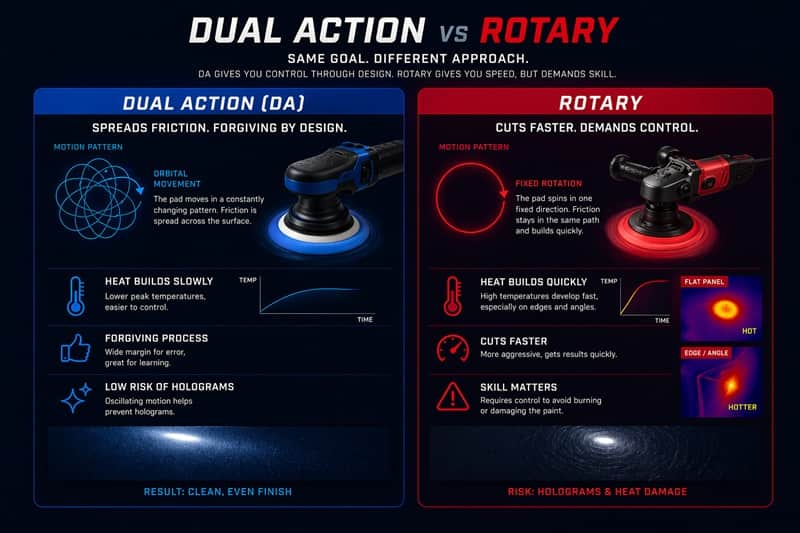
Holograms are the most common result of poor rotary technique — and understanding why they happen is important. It’s usually a combination of factors working against you at the same time. The fixed, directional rotation is the starting point — unlike a DA, the machine is always moving in the same pattern, which means any marks left in the paint follow that same direction. But the rotation alone doesn’t cause holograms. What usually tips it over the edge is heat.
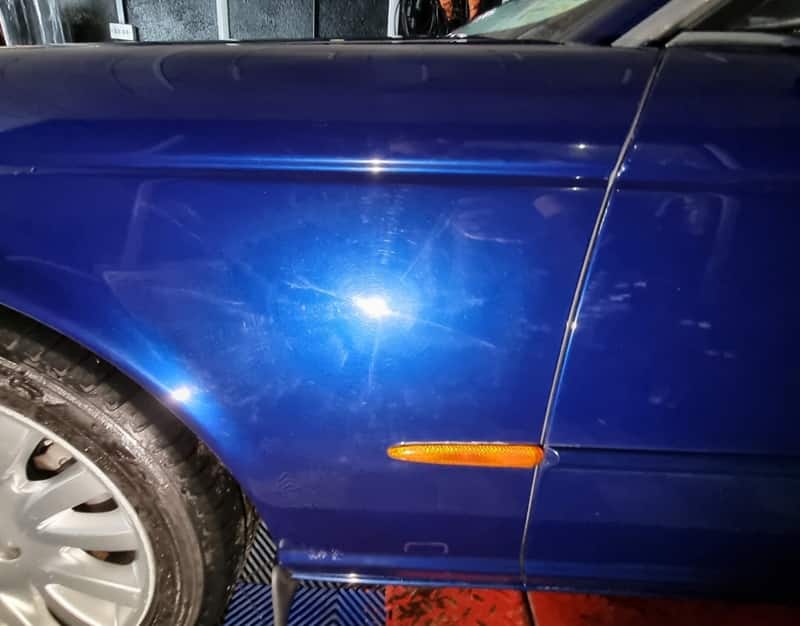
When the panel gets too hot, the compound starts to dry out and harden on the surface. At that point, instead of a lubricated abrasive doing controlled work, you effectively have a hardened paste being dragged across the paint in a fixed direction. The result is fine scratches running in line with the machine’s rotation — and that’s what holograms are. Add an overly aggressive compound into that mix, and the problem gets worse fast.
This is why temperature management isn’t just one skill among many when using a rotary — it’s the central one. Keep the panel cool, keep the compound working properly, and most hologram problems disappear.
DA or Rotary Polisher — Which One Should You Be Using? #
If you’re earlier in your detailing journey, a DA polisher is the right tool — not because the rotary is too dangerous to touch, but because a DA lets you focus on understanding the process without heat management being a constant concern. You can develop your understanding of machine speed, pressure, arm movement, and pad selection without the added complexity of actively monitoring panel temperature.
Once you have that foundation, a rotary becomes a much more accessible tool. The skills you’ve built — reading the paint, controlling pressure, working at the right pace — transfer directly. The main thing you add is temperature awareness.
For professionals working on hard, heavily defected paint where speed matters, the rotary earns its place. On certain cars — particularly with hard, seriously damaged paint — a rotary with a wool pad will cut faster than any DA. That said, a well-used 21mm DA with the right combination is also capable of a lot, and the difference isn’t always as dramatic as people assume. It comes down to the specific paint, the condition, and the combination being used.
DA vs Rotary — The Short Version #
The real difference between these two machines comes down to how they handle heat.
A DA spreads friction across a constantly changing pattern — heat builds slowly, the process is forgiving, and the risk of holograms is low. A rotary drives friction in a fixed, continuous rotation across the whole surface — it cuts faster, but heat builds quickly across the panel, and on edges and angled surfaces that heat builds even faster. Managing that is the skill that separates good rotary work from damaged paint.
Both machines work. Both have their place. Understanding what’s actually happening when you use them is what lets you get the most out of either one.
For a closer look at DA polisher throw sizes and how to choose between them, that’s covered in the knowledge base.
Have a question or something to add? Drop a comment below — whether it’s a question, your own experience, or something you’d do differently. We read everything.


Leave a Reply
You must be logged in to post a comment.

Leave a Reply #