









The Best Polishing Machine

Best Polishing Machine – How to Choose the Right One Without Making Costly Mistakes
Is polishing machine the main factor to polish paint properly?
No.
And this is the first thing you should consider.
A polishing machine is only part of the system.
By itself, it does not polish paint.
Most people starting with car detailing ask the same question:
“Which polishing machine should I buy?”
Very quickly, another one follows:
“Which one is the best?”
The truth is simple:
a polishing machine alone does not polish paint.
Every effective polishing process always consists of these elements:
- a polishing machine
- polishing pads (foam, microfiber, wool)
- polishing compounds
- and above all- proper technique!
The most expensive machine on the market, used without proper technique and with the wrong pad and compound, will not produce better results than a cheaper machine used correctly and matched to the task.
The main difference between high-end machines and solid mid-range machines is usually:
- better comfort
- lower vibration
- improved ergonomics
This matters in daily professional use, which is why sometimes it makes sense to pay more.
However, the most important thing is always understanding how the machine works and what it can actually do.
How should you choose a polishing machine?
Your choice should not be based on price, but on a few key questions.
What is your experience level?
Are you a beginner?
Do you already have some experience but still struggle with results?
Are you a professional polishing cars every day?
What is your budget?
What kind of work do you want to do?
Do you want to:
- remove deep defects?
- focus on finishing?
- perform one-step polishing?
How important are safety and control?
Do you want maximum safety?
Can you control more aggressive tools?
Your answers will automatically narrow down the right machine type.
What types of polishing machines are available?
There are three main types of polishing machines on the market:
- Dual Action (DA)
- Gear Driven Dual Action
- Rotary
Ignoring brand, price, and appearance, the most important difference is the type of movement the machine transfers to the backing plate and pad.
This movement directly affects:
- cutting power
- safety
- heat generation
- working speed
How does a Dual Action polishing machine work?
A Dual Action machine performs two movements at the same time:
- orbital movement (forced by the machine)
- rotational movement (created by centrifugal force)
The orbital movement is always present.
The rotational movement appears only when:
- the machine is kept flat
- pressure is correct
Too much pressure or tilting the machine can:
- slow down rotation
- stop it completely
Beginners often do not notice this because the orbital movement continues.
However, without rotation, defect removal becomes very difficult.
Why is Dual Action the safest polishing machine?
Dual Action machines:
- do not generate excessive heat
- are the most forgiving
- significantly reduce the risk of paint damage
- deliver very good finishing results
This is why they are the most popular choice for both beginners and professionals.
What does throw (orbit) mean in a Dual Action machine?
The throw (orbit) determines:
- cutting power
- working speed
- finishing quality
The most common throws are:
- 9 mm
- 15 mm
- 21 mm
When is a 9 mm Dual Action the best choice?
A 9 mm DA:
- works best on soft paint systems
- removes a surprising amount of defects despite low aggression
- delivers the cleanest possible finish
- is the easiest to control
On harder paint:
- correction is still possible
- but it takes more time and more passes
This makes it:
- an ideal entry-level machine for beginners on a budget
- an excellent professional tool for delicate paint systems
Recommended machine
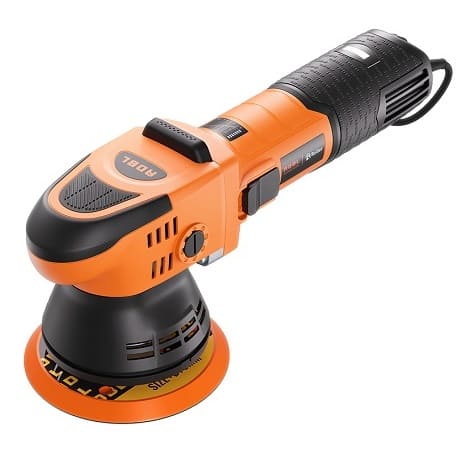
ADBL Dual Action 9 mm.
We have used it for years in our studio.
A major advantage is the included 3” backing plate, eliminating the need for a second machine for small areas.

When should you choose a 15 mm Dual Action?
A 15 mm throw is the perfect compromise between:
- the control and finish of a 9 mm
- the cutting speed of a 21 mm
A 15 mm DA:
- works very well on medium-hard paint
- is excellent for one-step polishing
- offers a great balance between cut and finish
It can be used for correction, but on harder paint the fastest results come from microfiber or wool pads.
Recommended machines
For professional use, our favorite is Rupes LHR 15 Mark III, one of the most comfortable machines on the market.
If your budget is more limited, excellent alternatives are:
Final results are very similar – the main difference is comfort, not performance.

When is a 21 mm Dual Action the right tool?
A 21 mm DA:
- offers the highest cutting power among DA machines
- performs best on hard paint systems
- significantly reduces correction time
- still remains a safe machine
This is clearly a tool:
- for professionals
- for large panels and efficiency
Recommended machine
ADBL Dual Action 21 mm.
It supports 5” and 6” backing plates.
In practice, 6” works best on large panels, while smaller plates often increase vibration on long-throw machines.

What is a Gear Driven Dual Action machine?
A Gear Driven DA combines:
- orbital movement
- forced rotation via gears
This means:
- rotation never stalls under pressure
- higher working pressure is possible
- correction is faster
Compared to standard DA:
- cutting power is significantly higher
- paint temperature increases more
- it remains far safer than a rotary
This machine excels at:
- hard paint
- heavily damaged paint
- aggressive one-step polishing on hard clear coats
Finishing is more demanding than with a standard DA, which is why it is not ideal as a single-machine solution.
Recommended machine
Makita PO6000.
Paired with a 9 mm or 15 mm DA, it creates a very effective professional setup.
What makes a rotary polishing machine different?
A rotary machine performs only rotational movement.
All motor power is transferred directly to the pad.
Typical speeds:
- approx. 600–800 RPM on low settings
- up to 2500–3000 RPM at the highest setting
This results in:
- very fast heat build-up
- high risk of mistakes
Overheated paint becomes soft and “rubbery”, and despite high aggression, cutting efficiency may actually decrease compared to Gear Driven or DA 21 mm machines.
A rotary is:
- strictly for heavy cutting
- best on hard and severely damaged paint
- not suitable for one-step polishing
- not for beginners
Recommended machines
In practice, we use:
- ADBL Rotary (5” and 6” backing plates)
- Liquid Elements Rotary


If budget is not an issue:
- Flex is an excellent choice
We most often work with wool pads, as they generate less heat than foam while maintaining strong cutting power.
Final thoughts – what is the best polishing machine?
There is no single best polishing machine.
The best machine is the one that:
- matches the paint
- matches the task
- matches your skill level
Understand the movement.
Control the temperature.
Choose the right system.
Everything else is technique.